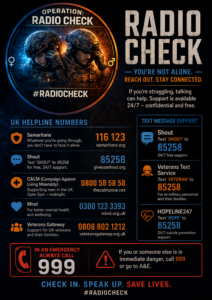
OPERATION RADIO-CHECK
Mental Health Is Mission Critical. Check Your Mates. No One Fights Alone.
We hear it everywhere: mental health matters.
We see the social media posts, the inspirational quotes, the awareness campaigns and the reminders to check in on the people around us. We share the messages, use the hashtags and talk about breaking the stigma.
But what happens when mental health stops being a conversation and becomes something we actually have to face?
What happens when someone we know starts to struggle ?
When Struggling Gets Misunderstood
What happens when someone becomes quieter than usual ?. When they withdraw from conversations, stop socialising, become easily frustrated or simply don’t seem like their usual self ?.
Too often, instead of asking what’s wrong, people make assumptions.
They’re labelled as moody, difficult, antisocial or told they’re overreacting. Their behaviour becomes the problem, while the pain behind it goes unnoticed.
But what if there’s more to the story ?
What if that person is exhausted from fighting battles nobody else can see ?. What if they’re doing everything they can just to get through the day, holding themselves together by a thread while the world expects them to carry on as normal ?.
Not every struggle is visible. Not every battle comes with obvious warning signs. And not everyone who is hurting knows how to explain what they’re going through.
Sometimes, what looks like a bad attitude is someone running out of energy. What looks like anger might be frustration, fear or emotional exhaustion. And what looks like someone pushing others away might actually be someone who doesn’t know how to ask for help.
We don’t always know what’s happening behind closed doors, and we shouldn’t assume that we do.
The People Who Say They’re Fine
One of the biggest misconceptions about mental health is that someone who is struggling will always show it.
They won’t.
Some people will continue going to work, fulfilling their responsibilities, making jokes, smiling and laughing with their mates. They’ll turn up, get the job done and tell everyone they’re fine.
From the outside, everything might look completely normal.
But behind that smile, they could be fighting a battle that nobody knows exists.
They might not want to burden anyone. They might feel embarrassed about admitting they’re struggling. They might worry that opening up will change how people see them. Or perhaps they’ve tried to speak before and felt dismissed, misunderstood or judged.
Eventually, some people stop talking about how they feel altogether.
And that’s the part we need to pay attention to.
Sometimes, the people who need support the most are the very people who have stopped asking for it.
Awareness Means Nothing Without Action
It’s easy to say mental health matters when it’s a slogan on a poster or a hashtag on social media.
It’s much harder to demonstrate that it matters when someone’s struggles begin to affect their mood, their behaviour or the people around them.
Real awareness means having patience when someone isn’t themselves. It means showing compassion when their behaviour is difficult to understand. It means recognising that people can be struggling even when they don’t have the words to explain why.
It means listening without immediately offering judgement, making assumptions or telling someone to simply pull themselves together.
And above all, it means remembering that you don’t have to fully understand someone’s battle to treat them with kindness.
We need to stop assuming silence is an attitude problem.
We need to stop dismissing pain as nothing more than a bad mood.
We need to stop expecting people to reach breaking point before we take their mental health seriously.
Because mental health support shouldn’t come with conditions. People shouldn’t have to hide their struggles to make others comfortable.
And nobody should feel that they have to pretend everything is okay just to be accepted.
Check Your Mates. Really Check Them.
Sometimes, making a difference doesn’t require grand gestures, perfect words or having all the answers.
Sometimes, it starts with a simple question:
“Are you okay ?”
Not the quick question you ask while walking past someone. Not the one you ask out of habit before moving on with your day.
Ask because you genuinely want to know.
Give them the time and space to answer honestly. Listen without judgement. Don’t force them to talk if they’re not ready, but let them know the door is open whenever they are.
Check in again a few days later. Send that message. Make that phone call. Invite them out, even if they say no the first time.
And if someone tells you they’re struggling, don’t underestimate what it might have taken for them to say those words.
You don’t need to be a counsellor or have a solution to every problem. Sometimes, simply being present and helping someone feel less alone can make a meaningful difference.
Most importantly, don’t disappear just because someone’s struggle becomes uncomfortable or difficult to understand.
That’s when compassion matters most.
OPERATION RADIOCHECK: No One Fights Alone
At OPERATION RADIOCHECK, the message is simple: mental health is mission critical.
In any team, you look out for one another. You check your equipment, communicate with your mates and make sure nobody is left behind.
So why should looking after each other mentally be any different?
You don’t need to wait for a crisis to check in. You don’t need a special occasion to ask how someone is doing. And you certainly don’t need to wait until someone breaks down before showing them that they matter.
A message, a conversation, a bit of patience or simply making time for someone can be more important than you’ll ever realise.
We may not always see the signs. We may not always know the right thing to say. But we can all choose to be more understanding, more compassionate and more willing to listen.
Because behind every callsign, every uniform, every smile and every strong exterior is a human being.
And every human being deserves to be heard.
The Mission Is Simple
Check your mates. Listen without judgement. Look beyond the behaviour. Make space for honest conversations.
Don’t wait until someone reaches their lowest point before you start listening.
Don’t let mental health awareness become something we talk about publicly but ignore when it becomes inconvenient in real life.
And never underestimate the difference you could make by showing someone that they don’t have to face everything alone.
OPERATION RADIOCHECK
Mental Health Is Mission Critical.
Check Your Mates.
No One Fights Alone.
Because nobody should have to reach breaking point before somebody starts listening. Drop a follow and like for updates over on our Social Media Platforms.
Facebook: https://www.facebook.com/1040229392514048?ref=PROFILE_EDIT_xav_ig_profile_page_web
Instagram: https://www.instagram.com/official_radio_check_?